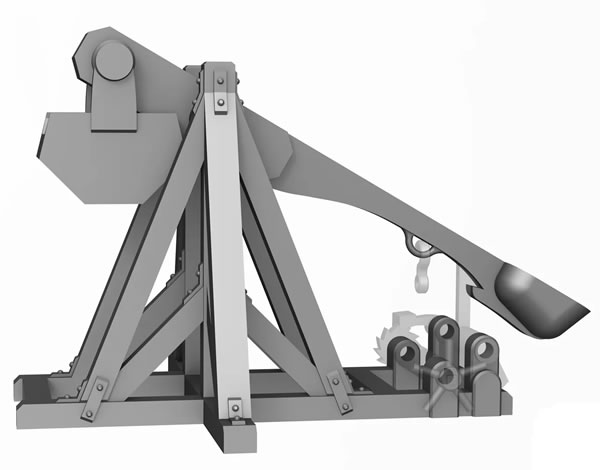
 Designing a 3D printable desktop Trebuchet
In March 2025, I had a sudden urge to design a 3D printable Trebuchet, something small enough to fit on a tabletop, for our gaming buddies, but also something that could theoretically work. All in all it probably took me maybe 6 weeks of on and off tinkering, along with several prototypes, before I came up with something that I felt was easy to print, and good enough to meet its purpose.
I was thrilled with its success, and in just a few weeks it reached 20,000 downloads across various download libraries.
I think the fact that it worked was a big deal for most, but unfortunately some users will always feel a little let down by performance. This project is designed as a mechanically interesting, safe, fantasy trebuchet model for display, learning, and light demonstration — not as a high-energy launcher. It's a fun build... taking an ordinary domestic FDM printer and making something we all recognised as an ancient siege weapon.
We all remember from our schooldays that mass moves mass, and something this lightweight and flexible will always be restricted by its physical size and, more importantly, the laws of physics.
This 3D printed trebuchet is a scaled demonstration model, designed primarily for fun, education, and display. While it does feature moving parts and is capable of launching a small projectile, its performance should be viewed in the context of its materials, scale, and simplified design.
It might surprise some that this trebuchet doesn’t launch very far. But this is actually entirely expected when you understand the physics and constraints involved.
The bucket forming the counterweight can only hold a modest amount of dense material (e.g., coins, copper, or steel shot). This limits the amount of potential energy available to drive the arm.
Historically, trebuchets used a sling to multiply the speed of the projectile at release. This model omits the sling for simplicity and printability — which naturally reduces launch efficiency.
PLA plastic isn’t ideal for energy transfer. It flexes slightly under load, and friction at pivot points absorbs energy, further reducing projectile velocity.
Let’s do a rough calculation to understand the expected performance.
Potential Energy of the Counterweight:
m = 0.15kg (150g copper shot)
h = 0.1m (10cm drop height)
g = 9.81 m/s²

Eₚ = m × g × h = 0.15 × 9.81 × 0.1 = 0.147 J
Assuming ~15% efficiency:
Eₖ = 0.147 × 0.15 = 0.022 J
Projectile mass = 2.1g = 0.0021 kg

v = √(2 × E / m) = √(2 × 0.022 / 0.0021) ≈ 4.58 m/s

Range ≈ v² / g = (4.58)² / 9.81 ≈ 2.14m (7 feet)
In practice, real-world losses and air drag reduce this significantly. A launch range of ~2 feet is completely realistic and expected.
This trebuchet is a miniature machine, built to demonstrate motion and mechanics — not battlefield power.
Ideal for:
If you’re after sheer power or distance, a larger build with denser materials, real bearings, and a sling would be required. But for what this model is — a small-scale, self-contained trebuchet with printable parts — the performance is just right. Alternatively, look at my Onager project, which for something made of the same material, blew my mind with distances of around 20 feet!
